Introduction
Manufacturing is now spread across many countries. A product may use components made in different countries, undergo processing in another country, and be finally assembled somewhere else. This makes country of origin determination more complex for global supply chains. A product’s country of origin is not always the same as the country from which it is shipped. Customs officials usually consider the location of the product’s manufacture, as well as whether proper processing or major change happened in compliance with the proper origin rules.
This matters because country of origin can affect customs duties, trade agreements, tariff benefits, import restrictions, and customs compliance. For example, the WTO reported in May 2026 that work on rules of origin was updated to cover areas such as preferential and non-preferential origin, proof of origin, cumulation, and self-certification. On July 1, 2026, the EU also introduced changes to the non-preference proof of origin processes. Also, managing correct origin data between suppliers, parts, and production locations is becoming an important part for handling global supply chain risk and compliance for companies that use distributed manufacturing.
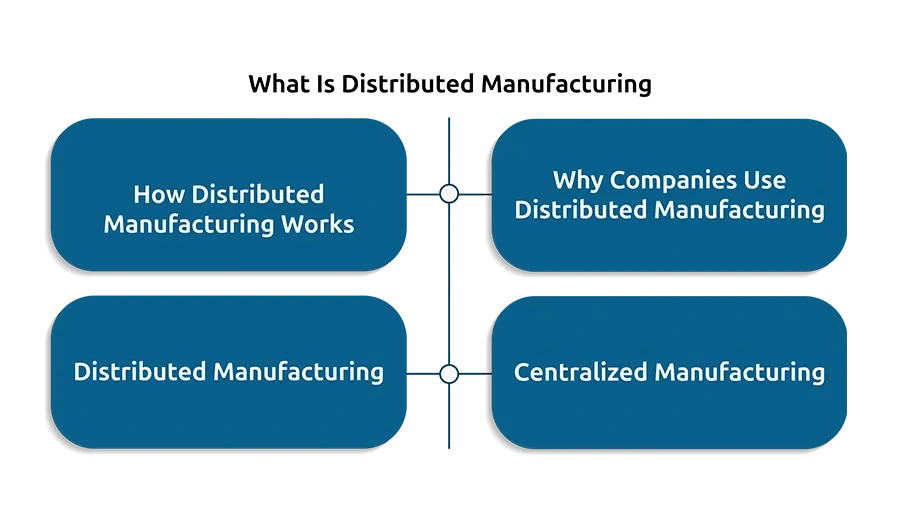
What Is Distributed Manufacturing?
Making a product across different places rather than depending on a single factory is known as distributed manufacturing. Different suppliers, regional centers, contract suppliers, and assembly sites that work as a single manufacturing network can all be used by a company. The main goal is to place the right production work in the right location while keeping the process connected.
How Distributed Manufacturing Works
In this model, different parts of production can happen in different places. One supplier may make components, another facility may handle production, and a regional site may complete final assembly closer to customers. Shared data, quality standards, planning, and logistics help connect these locations.
Why Companies Use Distributed Manufacturing
Companies use distributed manufacturing to reduce dependence on one production site and respond more easily to changes in demand. Having production in different locations can also improve flexibility and help manage supply chain disruptions. A 2025 study found that geographic diversification of manufacturing locations can support better customer and business performance while reducing disruption risk.
Distributed Manufacturing vs Centralized Manufacturing
With centralized manufacturing, most industrial takes place in one or very few of places. While it is typically simpler to handle, the business may depend even more on those locations. By distributing production across multiple locations, distributed manufacturing can provide companies more flexibility in response to changing supply or demand. However, country of origin tracking may become more challenging, and suppliers and facilities need to better location. Many companies combine both methods to create a mixed manufacturing network which involves regional standards, big factories, and many suppliers.
Why Country of Origin Becomes Difficult in Distributed Manufacturing
When a product is developed in multiple countries, it becomes more difficult to identify its country of origin. For example, parts may be produced in one country, Parts may come from a third, and final setup may take happen in a fourth. The product may then be shipped from yet another location. In such cases, the shipping country is not automatically the origin country. Customs rules may instead look at the processing or substantial transformation that took place.
This makes origin traceability important for companies using global sourcing and multi-country manufacturing. They need clear information about where components came from, what work was done in each location, and where the final product gained its required characteristics. The exact test can vary by product and applicable trade rules.
How Rules of Origin Affect Tariffs and Trade Agreements
Rules of origin helps in finding the trade and tariff regulations that apply to a given goods. Goods may be approved for preferred tariffs, reduced charges, or even zero-duty clearance if they meet the required origin rules defined in a trade agreement. The business can lose these benefits and come under to higher charges or other customs payments if the origin details are incorrect or the product is rejected.
Import limits, tariffs, anti-dumping taxes, and anti-subsidiary policies may all be affected by the country of origin. For this reason, correct origin details are important for following with customs regulations, specifically when goods are manufactured across multiple countries.
How Distributed Manufacturing Changes Origin Determination
When production is spread across several countries, origin determination needs more detailed information. Companies may need to know the component origin, supplier origin, manufacturing location, assembly location, and processing activities. They also need accurate Bill of Materials (BOM), HS classification, local value added, and records of production or supplier changes. These details help show how a product was made and support the correct origin calculation.
Good BOM origin data, supplier origin data, and component-level data improve component traceability and manufacturing traceability. Companies can use origin management systems and other digital tools to connect this information and improve supply chain visibility. For complex products, automated tools can also make origin calculations easier, but the result still depends on having accurate supplier and product data.

Conclusion – Better Origin Data Supports Stronger Global Supply Chains
Distributed manufacturing allows companies more flexibility, but it also makes tracking the country of origin more difficult. Companies can handle tariffs, customs compliance, and trade agreements with the help of correct origin data. Additionally, it makes the supply chain more resilient and clearly visible. Origin data should be viewed by companies as more than just document; it is a major supply-chain asset. Clear origin records also help companies make better sourcing decisions. They can respond faster when suppliers, production locations, or trade rules change.
Did You Know
The global distributed manufacturing market is accounted for $32.5 billion in 2026 and is expected to reach $89.5 billion by 2034 growing at a CAGR of 13.5% during the forecast period.
FAQ
Does final assembly always decide the country of origin?
No. Final assembly alone may not be enough. The applicable rules of origin determine whether the work done there is sufficient.
How can supplier changes create customs risk?
If a supplier changes the source of a component, the product’s origin calculation may also change. Companies should review the impact before making the change.
Why is origin tracking harder in distributed manufacturing?
Production may happen at different locations, with different suppliers and processing steps. This makes origin determination more difficult.
How does global sourcing affect origin management?
With global sourcing, components may come from many countries, so companies need better records to track their origin and production history.
Why is origin management important for complex products?
Complex products often contain many components from different suppliers. Good origin management helps companies track this information and support accurate customs declarations.