Introduction
As AI development works worldwide, organizations are developing AI training clusters across many countries to support large-scale model training & high-performance computing. However, changing GPUs, AI servers, networking equipment, & storage systems across borders needs more than standard shipping. Cross-border logistics involves customs compliance, secure transportation, regulatory approvals, & usable supply chain coordination to ensure AI network is delivered on time & ready for development.
What Are AI Training Clusters?
AI training clusters are huge networks of high-performance servers, mainly equipped with GPUs or TPUs. They are specifically used to provide the huge computational workload need to train difficult machine learning models across thousands of processors.
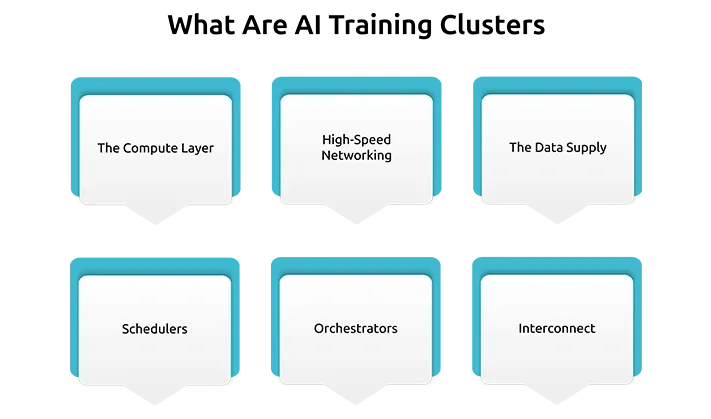
Key Components
The Compute Layer: Groups of tens of thousands of specialized processors (like NVIDIA GPUs or Google TPUs) that perform huge parallel computations.
High-Speed Networking: The “interconnect” fabrics such as NVLink inside a single server & fast InfiniBand across servers that connect the thousands of processors. This secure data issues while models learn.
The Data Supply : Ultra-high-speed storage systems capable of continuously feeding many training datasets & saving model checkpoints.
Schedulers & Orchestrators: Software like Kubernetes or Slurm that act as the brain of the cluster, distributing jobs, managing health, & allocating resources.
Why They Are Necessary
AI training clusters are useful because updated artificial intelligence models need huge computational power that cannot be provided by a single processor or server. During the training of deep learning models & large language models, systems must process trillions of data points & perform billions of calculations simultaneously. If this workload were assigned to a single processor, training could take months or even decades to complete. By distributing these computations across hundreds or thousands of GPUs working in parallel, AI training clusters mainly reduce training time & enable organizations to develop sophisticated AI models easily. Many updated AI models are too large to fit into the memory of a single GPU or computing device.
Infrastructure Challenges
AI training clusters place extraordinary demands on physical infrastructure because they combine thousands of high-performance GPUs, servers, storage systems, & networking devices operating simultaneously. As these clusters continue to grow in size, they push the limits of traditional data center capabilities. One of the biggest challenges is power consumption. Modern AI training clusters can require power capacities approaching 1 gigawatt (GW), comparable to the electricity needs of a small city. Meeting these energy requirements requires robust electrical infrastructure, redundant power supplies, & careful capacity planning.
Another important challenge is cooling. AI accelerators & GPUs operate mainly at near-maximum utilization during model training, generating immense amounts of heat. Conventional air-cooling systems are often insufficient to manage safe operating temperatures for dense AI deployments. As a result, many organizations are adopting updated cooling technologies, such as direct-to-chip liquid cooling & immersion cooling, which enhance heat removal, improve energy efficiency, & support the usable operation of high-density AI networks.
Essential Logistics Components for AI Training Clusters
Global Freight Planning
Successful development of AI training clusters begins with a well-planned global freight strategy. Clients mainly select the most usable shipping method based on project timelines, budget, shipment size, & location. Air freight is often preferred for quick shipments of GPUs, AI servers, & networking equipment because it offers the fastest transit times, enabling companies to meet urgent development schedules. Ocean freight provides a more cost-friendly solution for shipping large volumes of racks, storage systems, cooling equipment, & other bulky network equipment when delivery timelines are more flexible.
Importer of Record
Many companies developing AI networks globally depend on Importer of Record services to improve global development. An IOR assumes legal responsibility for importing goods into a country by managing customs documentation, obtaining need permits, ensuring regulatory compliance, & coordinating duty & tax obligations where applicable. This is mainly valuable when businesses do not have a registered legal entity in the destination country. By using an experienced IOR provider, organizations can accelerate development timelines, minimize compliance risks, avoid costly customs delays, & ensure that AI hardware reaches data centers without unnecessary administrative issues.
Exporter of Record (EOR)
An Exporter of Record helps ensure that shipments follow the export rules of the country they are being shipped from. The EOR prepares the need export documents, obtains export licenses when needed, & makes sure the shipment meets all trade & export control laws & regulations. Since many AI servers, GPUs, & updated semiconductor technologies are subject to export restrictions in some countries, EOR services help businesses meet legal requirements, avoid shipment delays, minimize the risk of fines, & ensure their equipment is exported safely & legally.
Warehousing
Warehousing plays an important role in the easy delivery & development of AI training clusters across international markets. Temporary storage facilities provide a safe place to store equipment before it is installed or delivered to its final location. Warehousing also allows businesses to combine parts from different manufacturers into a single shipment, making transportation more useful. Good stock management gives businesses real-time visibility of their equipment, helping them track valuable AI hardware throughout the supply chain.
Conclusion
As AI training clusters become a main part of updated artificial intelligence, usable cross-border logistics plays an important role in their successful development. Shipping high-value equipment such as GPUs, AI servers, networking devices, & storage systems needs careful handling, customs compliance, safe management, & usable supply chain management. Services like Importer of Record, Exporter of Record, & important warehousing help businesses meet global laws, minimize shipping delays, & speed up the development of AI networks across international markets.
Did you know?
The supercomputing cluster will comprise 64 Cerebras Systems CS-3 systems and is expected to serve as a foundational asset for India’s sovereign AI ambitions.
FAQ
Why do AI training clusters require specialized logistics instead of standard freight services?
AI training clusters consist of high-value, sensitive equipment that requires secure handling, specialized packaging, customs expertise, and coordinated delivery to prevent damage, delays, and compliance issues.
Are GPUs and AI servers subject to export control regulations?
Yes. Many advanced GPUs, AI accelerators, and semiconductor technologies are classified as dual-use items and may require export licenses or additional regulatory approvals depending on the destination country.
How does cross-border logistics impact AI deployment timelines?
Efficient logistics minimizes customs delays, ensures timely delivery of critical hardware, and helps organizations deploy AI training clusters faster without disrupting project schedules.
What factors should businesses consider when shipping AI training infrastructure internationally?
Businesses should evaluate customs regulations, freight options, cargo insurance, secure packaging, import/export compliance, and local delivery requirements before shipping AI hardware.
Can AI training cluster components be shipped from multiple countries to a single data center?
Yes. Through shipment consolidation, warehousing, and coordinated logistics planning, components sourced from different manufacturers and countries can be delivered together for seamless installation and deployment.