In the difficult world of global trade, successful transactions depend on clear communication and clearly defined commitment. The International Commercial Terms also known as Incoterms, are systematized trade norms that specify the roles, fees, and risks related to global goods delivery and transportation between buyers and vendors. A thorough hold of Incoterms 2026 is necessary for import and export performance to successfully arrange global trade.
What is meant by Incoterms?
The International Chamber of Commerce (ICC) publishes a set of globally accepted guidelines known as Incoterms. The roles of buyers and vendors across the region, including shipping, insurance, and customs clearance, are defined in a standard system. Incoterms make these requirements clear, which helps simplify global trade and reduce confusion among suppliers. Incoterms are used in international trade to help trading partners establish a common language and set of expectations. Global trade requires Incoterms, which clearly define the roles, risks, and costs that buyers and sellers have. All distributors are advised of their requirements by clearly defining who is in charge of each step of the shipping process, from packaging to shipment. Incoterms also specify exactly when the supplier is responsible for any loss or damage to the products, which helps to avoid misinterpretation. By defining who is responsible for costs such as shipment, insurance, and taxes, they also create cost designation, which simplifies financial planning and transaction execution. Because Incoterms address these problems, they are important for simplifying more effective transactions and simplifying global trade.
What is meant by Incoterms?
The International Chamber of Commerce (ICC) publishes a set of globally accepted guidelines known as Incoterms. The roles of buyers and vendors across the region deals, such as shipping, insurance, and customs clearance, are defined in a regular system. Incoterms make clear these requirements, which helps to make simple global trade and reduce confusion between suppliers.
The Purpose of Incoterms in Global Trade
Incoterms are used in international trade to help trading partners establish a common language and set of expectations. Global trade requires Incoterms, which clearly define the roles, risks, and costs that buyers and sellers. All distributors are advised of their requirements by clearly defining who is in charge of each step of the shipping process, from packaging and shipment. Incoterms also specify absolutely when the supplier is responsible for any loss or damage to the products, which helps to avoid misinterpretation. By developing who is responsible for costs such as shipment, insurance, and taxes, they also create cost designation, which simplifies financial planning and transaction execution. Because Incoterms direct these problems, they are important for simplifying more effective transactions and simplifying global trade.

Key Incoterms Explained
Knowledge of the various Incoterms is vital for making informed decisions in your import and export operations. Below are some of the most frequently used terms:
EXW (Ex Works)
Under EXW Incoterms, the customer bears all additional transportation risks and expenses when the vendor makes the products available at their location. The buyer bears the greatest amount of liability under this clause.
FCA (Free Carrier)
According to FCA Incoterms, the seller ships the goods to a transporter or another party chosen by the buyer at the vendor’s or another specified location. Within a week of shipping, the seller manages export clearance, but the supplier is in charge of all risks and fees.
CIF (Cost, Insurance & Freight)
Incoterms appeal payments from the vendor for the fees, and insurance required to deliver the products to the port of locations. but, the buyer takes all risk once the goods are loaded onto the shipping container.
DAP (Delivered At Place)
Under DAP Incoterms, The sellers ship the goods to the specified location so they can be empty. The vendor takes all risks and fees regarding shipping to that location, while the customer is in charge of import taxes.
Delivered Duty Paid
DDP Incoterms designates the greatest amount of commitment to the seller, who ships the goods to the buyer’s address and takes all fees, including import taxes and duties. Only unloading the goods when they arrive is the buyer’s responsibility.
The Importance of Incoterms in International Business
Incorporating the appropriate Incoterms into your contracts offers several benefits:
Risk Management: It is easier to understand and reduce any risks related to delivery and shipment when terms are well-defined.
Cost Allocation: Accurate pricing and the avoidance of unexpected spending are simplified by understanding who takes responsibility for certain costs.
Legal Clarity: By establishing clear expectations for both parties, standardized terminology lessens the possibility of legal problems.
Incoterms and the Importer of Record
The importer of record is responsible for ensuring that goods are imported by regional laws, which includes paying taxes and filling out the necessary documentation. Who serves as the importer of record may vary depending on the Incoterm selected. For example:
Under EXW, the buyer typically serves as the importer of record, handling all import formalities.
With DDP, the seller supposes this role, taking on the responsibilities related to importing the goods into the distributor’s country.
Understanding this dissimilarity is pivotal for agreements and effective logistics management.
Industry-Specific Use of Incoterms 2026 in Modern Supply Chains
Selecting the right Incoterm plays a critical role in improving operational efficiency across aviation, IT, automotive, and healthcare sectors. Today’s global supply chains rely heavily on freight forwarding services, customs clearance, warehouse services, and Importer of Record (IOR) support to keep shipments compliant and on schedule. Understanding Incoterms 2026 helps businesses avoid delays “in transit,” optimise storage and warehousing solutions, and ensure seamless movement of sensitive goods—from MRO supply chain parts and telecom hardware to medical devices and automotive components. By aligning the correct Incoterm with your supply chain strategy, companies gain better visibility, lower risks, and achieve smoother international shipping workflows.
Industry-Specific Considerations for Incoterms
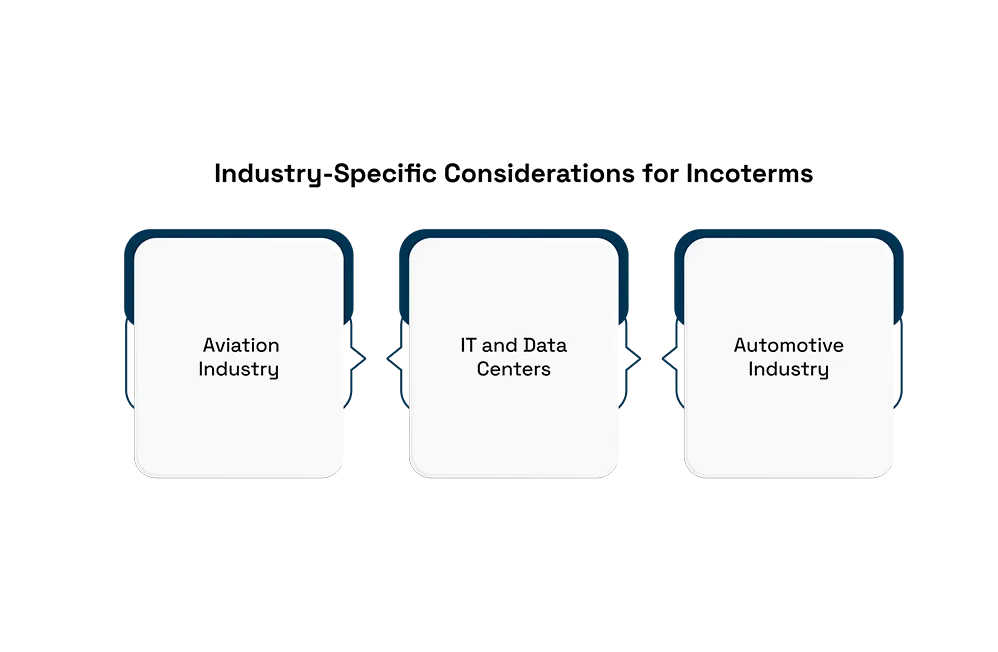
Every industry has different logistics needs, and operations can be greatly impacted by the Incoterm selection. Below are key sectors and how Incoterms 2026 applies to them:
1. Aviation Industry
The aviation sector involves the motion of valuable and time-sensitive equipment. Incoterms such as FOB, CIF, and FCA are commonly used to confirm effective global distribution. Confirming a clear knowledge of global shipping Incoterms in this sector is critical for reducing shipping delays.
2. IT and Data Centers
Shipping IT hardware, servers, and networking equipment frequently requires DDP Incoterms, Its delivery to the data center and customs clearance are fully the seller’s responsibility. This confirms approval with local laws and stops unexpected customs fines.
3. Automotive Industry
In automotive manufacturing, various components are sourced from different countries. CIF Incoterms are widely used to cover freight and insurance costs. Additionally, EXW vs. DAP Incoterms is important because DAP increases seller accountability, which benefits manufacturers who rely on just-in-time supply chains.
4. Medical and Healthcare Centers
Strict regulatory requirements must be met by medical equipment. By using DDP Incoterms, any regulatory obstacles to healthcare providers receiving equipment are eliminated and the vendor’s obligations are guaranteed to be fulfilled. Using FCA Incoterms also ensures that medical devices are transferred to trustworthy carriers.
How Incoterms 2026 Improve Compliance and Customs Clearance Efficiency
In global logistics, smooth customs processing is essential for avoiding penalties and delays. Incoterms 2026 provide the structure needed to manage customs clearance, classify goods using the Harmonized System Code (HS Code) or HTS, and meet international trade compliance standards. When combined with reliable freight forwarding services, DDP shipping support, and expert Importer or Exporter of Record guidance, businesses can prevent issues during international ecommerce shipping or multimodal transport. These clear responsibilities help companies reduce risks, maintain sustainable trade practices, and strengthen supply chain best practices from origin to final delivery.
Choosing the Right Incoterm
Selecting the appropriate Incoterm depends on various factors, including:
Mode of Transport: Certain phrases are unique to transportation by sea and inland waterways. (e.g., FOB, CIF), Others, however, can be used with any kind of transportation. (e.g., EXW, DAP).
Level of Control: Decide how much control and responsibility your company wants over the shipping process.
Cost Considerations: Determine which party is more capable of managing specific expenses.
For example, comparing EXW vs. DAP Incoterms:
EXW puts additional costs and duties on the buyer, who manages all transportation from the seller’s location.
DAP requires the seller to manage transportation to the destination, while the buyer is responsible for import duties and offloading.
Understanding these differences enables you to make strategic decisions that complement the goals and advantages of your business.
Conclusion
A thorough understanding of Incoterms 2026 is crucial for companies engaged in international trade. In addition to making international trade easier by providing clear guidelines, these terms are crucial for risk management, cost allocation, and legal compliance. Every transaction can foster stronger relationships with foreign partners and increase operational effectiveness by choosing the right Incoterm business.
Did You Know?
DDP (Delivered Duty Paid) gives the seller the highest level of responsibility among commonly used Incoterms. The seller manages transportation, customs clearance, duties, and taxes until the goods reach the buyer’s destination.
FAQ
1. What is the concept of global trade?
Global trade is the exchange of goods and services between countries to meet demand and supply needs worldwide. It helps nations expand markets, improve access to products, and support overall economic growth.
2. What is the difference between EXW and DDP Incoterms?
EXW places most transportation, customs, and risk responsibilities on the buyer, while DDP places nearly all responsibilities, including duties and taxes, on the seller until the goods reach the buyer.
3. Who is responsible for customs clearance under Incoterms?
The responsibility for customs clearance depends on the selected Incoterm. Some terms place this obligation on the buyer, while others require the seller to handle export or import formalities.
4. What are the three categories of international trade called?
The three main categories of international trade are import trade, export trade, and entrepot (re-export) trade. These categories describe how goods are brought into a country, sent out to other countries, or re-exported after import.
5. How do Incoterms help reduce risks in international trade?
Incoterms clearly define the transfer of risk, allocation of costs, and responsibilities between buyers and sellers, helping reduce disputes and improve supply chain efficiency.