Importance of global trade in medical diagnostics
International trade in medical diagnostics is useful for ensuring honest access to healthcare, using rapid responses to global health emergencies, & developing innovation. It allows countries to share updated technologies, such as imaging equipment & laboratory testing kits, which are often developed in one country, made in another, & deployed in the whole world. The market, expected to grow from USD 203.3 billion in 2024 to over USD 274 billion by 2034, is not independent of an international network to meet the growing demand for fast, correct diagnosis.
Understanding Diagnostic Equipment in Global Trade
The global diagnostic equipment market, valued at around US$40–45 billion, involves importing & exporting high-tech imaging, in vitro diagnostics, & point-of-care devices. Trade is managed by growing demand for fast, accurate diagnostics to manage long-term diseases, with major growth in digital tools & AI, used by improved international trade agreements.
Types of diagnostic equipment
Diagnostic equipment with tools used to detect, measure, & verify health conditions, with basic tools like thermometers & stethoscopes to update imaging systems & laboratory analyzers. These devices, like sphygmomanometers & ECG machines, are useful for verifying diseases & managing patient health.
Main categories of diagnostic equipment:
Imaging Diagnostic Equipment
Diagnostic imaging equipment plays an important role in growing healthcare by making visual representations of the body’s internal structures to diagnose injuries, diseases, & medical conditions. These devices help doctors verify health issues correctly & plan effective treatments. Main types of diagnostic imaging equipment with CT scanners, which produce detailed cross-sectional images of internal organs & tissues; MRI machines, which use magnetic resonance technology to make high-resolution images of soft tissues & organs; ultrasound machines, which use sound waves to monitor organs & fetal development; & X-ray machines, mainly used for verifying bones & detecting conditions such as pneumonia. Mammography units are another important category, mainly made for breast cancer screening & early detection.
Managing & Diagnostic Devices
Managing & diagnostic tools are useful medical devices used to measure main signs & track patient health metrics in real time. These networks help healthcare professionals continuously monitor a patient’s condition & detect issues quickly. Common examples include electrocardiographs (ECG/EKG), which record the electrical activity of the heart to identify cardiac disorders, & sphygmomanometers, which are used to measure blood pressure levels. Pulse oximeters monitor oxygen saturation in the blood, making them especially important in respiratory care. Electroencephalographs are used to measure brain activity & diagnose neurological conditions, while thermometers help assess body temperature to detect fever & other health issues.
Key Tax Structures Affecting Diagnostic Equipment Trade
Moving into 2026, the tax structure for diagnostic equipment in India has faced important rationalization, aiming to use healthcare costs & boost domestic manufacturing.
Key Tax Structures & Rates (Post-Sep 2025):
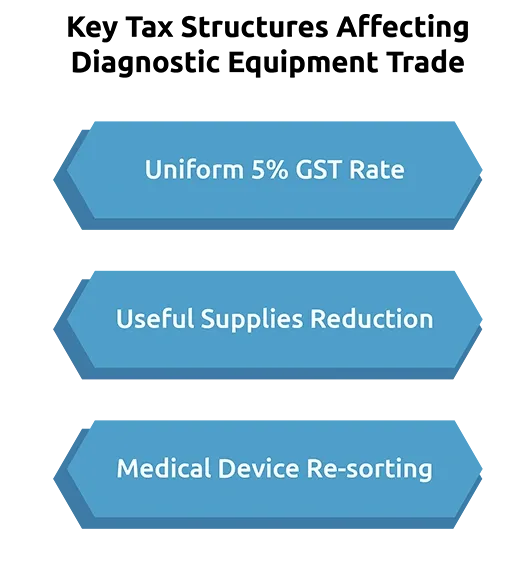
Uniform 5% GST Rate: Effective from September 22, 2025, a broad range of diagnostic kits, reagents, ECG machines, & imaging equipment mainly attract a 5% GST rate.
Useful Supplies Reduction: Diagnostic kits, blood reagents, & laboratory supplies have seen their GST minimized from 12% to 5%, using the cost of diagnostic tests.
Medical Device Re-sorting: Most surgical, dental, & pet health-care diagnostic devices now fall under the 5% bracket, down from 18%.
Medical Furniture: Items such as hospital beds & stretchers generally attract an 18% GST rate.
Effect on Trade & Operations:
Inverted Duty Structure Concerns: Despite the lower tax on finished diagnostic products (5%), manufacturers often pay higher GST (18%) on raw material inputs, used to tax credit accumulation and blocked working capital.
Import Duties: High import duties on updated medical technologies continue to make imported equipment heavy in cost compared to locally produced ones.
Compliance & Transparency: The clear, minimized GST structure is used to improve tax compliance & use the supply chain.
“Make in India” Boost: The tax changes aim to bolster local manufacturing, aiming to minimize dependence on imported diagnostic machinery.

Conclusion
Tax structures are important for developing international trade in diagnostic equipment by influencing manufacturing costs, import costs, healthcare affordability, & market availability. As demand for updated diagnostic technologies continues to develop worldwide, governments are increasingly updating tax policies to cover healthcare usability with domestic industrial growth. Measures such as GST reductions on diagnostic devices & laboratory supplies can lower testing costs & improve access to useful healthcare services, while efforts promoting local manufacturing help minimize dependency on imports.
Did you know?
The agreement goes beyond goods and addresses services, a core strength of India’s economy. India exported over USD 19.8 billion in services to the UK, and CETA promises to expand this further. In a first for the UK, mobility for professionals across IT.
FAQ
1. What new medical device tariffs were implemented in 2025?
In 2025, the U.S. implemented a 10% universal baseline tariff on most imported medical devices. Specifically, higher tariffs were applied to China and a 20% tariff on EU imports, according to PTC.
2. How do tariffs affect the cost of diagnostic imaging equipment?
Tariffs on electronic components and specialized materials increase manufacturing costs, often adding \(\$2,000–\$8,000\) per device, which can lead to higher prices for MRI, CT, and X-ray systems, as reported by PTC and Shared Imaging.
3. What is the impact of the GST reduction on diagnostic equipment in India?
The Indian GST Council reduced GST on medical devices, including diagnostic kits, from 12% to 5% effective September 22, 2025, aimed at lowering the financial burden on patients, according to Kauvery Hospital and Mindray.
4. What is duty inversion in the medical device sector?
Duty inversion occurs when finished medical devices face lower taxes than input components, causing working capital pressure for domestic manufacturers, note ETHealthworld and Monika Arora from Deloitte India.
5. How do international trade tax strategies affect medical device companies?
Companies are adjusting to higher tariffs by diversifying supply chains, increasing the use of refurbished equipment, or moving manufacturing to tax-friendly regions to mitigate increased costs.