
Introduction
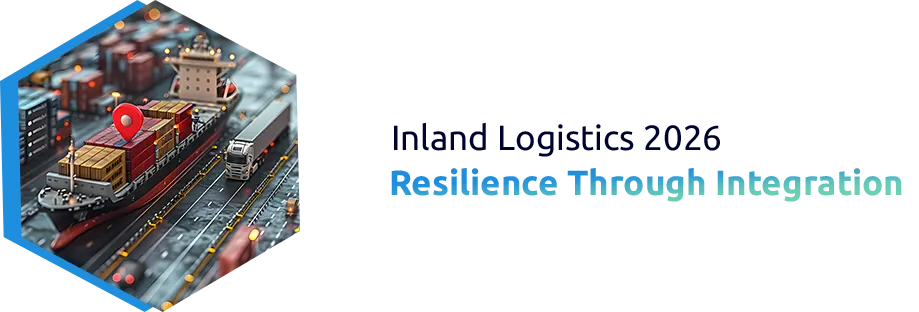
As global trade grows, inland logistics is becoming the support of supply chain resilience. In 2026, organizations will see growing transportation fees, approval risks, and increasing demand to deliver quickly across difficult routes. For industries such as IT, aviation, medical devices, and automotive manufacturing, these difficulties require more than conventional freight management. Organizations require a modern strategy that smoothly connects customs processes, inland movement, and regulatory requirements into a single, combined system.
Why Inland Logistics Visibility Matters in 2026
Real-time visibility has become a key factor in supporting efficient inland logistics operations. Businesses that can monitor shipment movement across every stage are better prepared to respond to unexpected delay & changing transport conditions. Improved visibility also supports better planning between warehouses, carriers, & delay centers, helping minimize transit delays. As supply chains become more complex in 2026, greater working visibility enables faster decision-making & more reliable inland deliveries.
Three inland moves the 2026 resilience plan.
To stay competitive in 2026, businesses must structure their inland strategy around three necessary logistics pillars:
1. Predictive Inland Planning
Organizations increasingly depend on inland hubs, cross-docking hubs, and near-port distribution methods to stabilize supply flow. Predictive planning includes growing demand, avoiding congestion zones, and using data-driven routing to reduce delays. For vital equipment such as servers, aircraft components, or medical machinery, predictive inland planning confirms sensitive shipments move with minimal disruption.
2. Integrated Customs Coordination
With changing global regulations, inland logistics cannot work independently of customs requirements. Integrated customs coordination allows faster border movement, reduces agreement risks, and stops unexpected delays. It also confirms all required documents, duties, and regulatory checks are worked with the inland logistics schedules.
3. Controlled Movement Through Trusted Partners
Inland resilience also depends on working with partners that understand the special shipping of high-value and technical cargo. IT servers, diagnostic medical equipment, and automotive tools required careful handling throughout the inland journey. Trusted partners confirm secure movement, continuous monitoring, and on-time delivery across state borders or national territories.
The One Union Solutions Inland resilience advantage
We provide a unique advantage in inland logistics planning for 2026, using our combination of approval expertise and advanced cargo handling capabilities. Businesses in IT, aviation, medical, and automotive manufacturing benefit from:
End-to-end shipment tracking from origin to inland location
Specialized management for sensitive equipment to avoid damage during logistics
Dedicated routing strategies built to avoid congestion, strikes, or regulatory delays
Smooth coordination between inland carriers and customs teams
Quick issue-resolution support to stop downtime
Tariffs and trade agreements will lead to the combination of supply chains.
The global trade landscape is changing quickly. As new tariffs and updated trade agreements show in 2026, supply chains across North America, Europe, and Asia will undergo huge restructuring.
These changes will influence:
How and where companies source components
Which inland routes become the most cost-effective
Which countries and regions will become major consolidation hubs?
How quickly businesses must adapt their customs processes
For many companies, this will push them to consolidate inland operations into short, more strategic hubs. It will also grow businesses to localize inland distribution where possible to reduce regulatory exposure and shipping time.
IT hardware, automotive electronics, medical devices, and aerospace components will be mainly impacted due to their multi-country shipping patterns. A single change in a tariff agreement can alter the cost structure of a complete inland route.
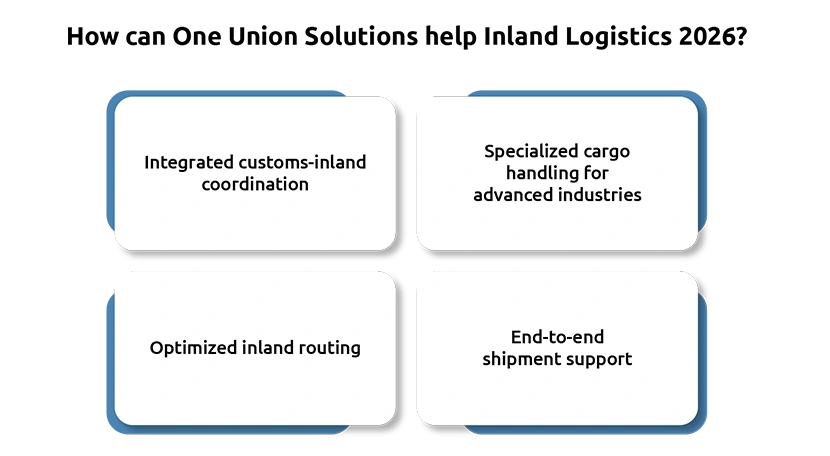
How can One Union Solutions help Inland Logistics 2026?
We support businesses in creating a stable and compliant inland logistics network for 2026 through:
Integrated customs-inland coordination
Confirming documentation, regulatory requirements, and shipment schedules are fully aligned for smooth inland logistics.
Specialized cargo handling for advanced industries
High-value equipment in IT, medical equipment,, aviation, and automotive industries is managed with precision, security, and dedicated care of shipment.
Optimized inland routing
Data-driven route planning minimizes logistics risks and accounts for trade policy changes, risk, and regional restrictions.
End-to-end shipment support
From initial planning to final inland delivery, we provide full visibility and quick resolution support to avoid downtime.
Approval work for evolving trade rules
As tariffs and agreements change, One Union Solutions keeps businesses updated and prepared, confirming inland shipments remain compliant at all times.
Conclusion
Inland Logistics 2026 is shaped by rapid regulatory changes, changing tariffs, and the increasing requirement for the correct shipment of valuable cargo. For industries such as IT, aviation, medical technology, and automotive manufacturing, inland dependence will depend on combined customs solutions, predictive planning, and trusted logistics partners. We empower businesses to guide this new landscape with secure handling, agreement expertise, and simplify inland work to withstand global disruption. Organizations that improve their inland logistics plan today to grow efficiency, dependability, and long-term competitiveness in 2026.
DID YOU KNOW?
According to the OECD’s 2026 Key Transport Statistics, freight transport by road and rail continues to play a central role in inland logistics across member economies, highlighting the growing importance of efficient inland transport networks for resilient supply chains.
FAQs:
1. Why is inland logistics becoming critical for supply chain resilience in 2026?
Inland logistics is gaining importance due to rising transportation costs, changing tariffs, and strong regulatory requirements. Companies need smoother work between inland movement and customs to avoid delays and protect high-value shipments.
2. How do tariffs and trade agreements impact inland logistics?
Tariff changes can increase or decrease route costs, impact sourcing options, and change combined hubs. Even a small tariff adjustment can reshape inland distribution strategies and overall supply chain cost structures.
3. What industries benefit most from integrated customs and inland solutions?
Industries such as IT hardware, aviation, medical devices, automotive, and semiconductor manufacturing benefit the most because they ship sensitive, high-value equipment that requires precise compliance and careful inland handling.
4. How does predictive inland planning help reduce logistics risks?
Predictive planning uses data to forecast demand, avoid congestion zones, bypass disruptions, and select optimized routes, confirming faster and safer inland movement for time-critical cargo.
5. How does One Union Solutions support inland logistics for 2026?
We provide integrated customs coordination, specialized cargo handling, optimized routing, end-to-end shipment visibility, and regulatory approval support as trade rules change.