Introduction
The quick growth of artificial intelligence is driving a global demand for updated computing networks. Businesses, cloud providers, research institutions, & technology companies are building large-scale AI development that mainly depends on high-performance GPU servers, AI accelerators, storage systems, & networking equipment. As these AI clusters expand across many countries, organizations must change valuable hardware quickly & securely while meeting the import needs of each location.
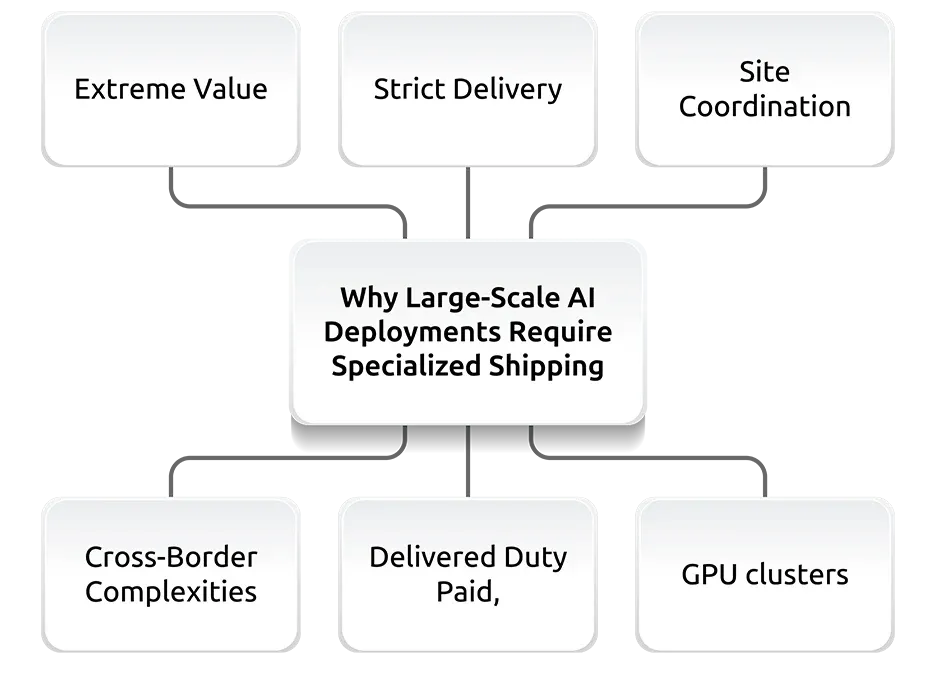
Why Large-Scale AI Deployments Require Specialized Shipping
Large-scale AI deployments need specialized shipping because the hardware such as specialized GPUs, processors, & fully configured server racks is mainly costly & highly sensitive to vibration. Moving these high-density infrastructure clusters demands updated logistics planning to protect the equipment & prevent costly project delays.
The main requirements driving the need for specialized AI logistics include:
- Extreme Value
AI server clusters are among the most valuable types of IT equipment, with a single rack costing up to $1 million depending on its configuration. These systems contain high-performance GPUs, processors, & other important semiconductor components that, with improper handling or sudden temperature changes during transportation, can be damaged. Because of their high value & delicate design, they require specialized shipping procedures to minimize the risk of damage.
- Strict Delivery & Site Coordination
Large-scale AI deployments operate on heavy schedules, making on time delivery an important part of the project. AI servers, GPU clusters, storage systems, & networking equipment must arrive exactly when installation sites are ready to receive them. Delays can issue deployment timelines, increase project costs, & postpone the availability of computing capacity. To avoid these issues, shipments are carefully coordinated with project managers, site teams, logistics providers, & installation contractors. Delivery schedules are aligned with site readiness, crane availability for unloading heavy equipment, warehouse access, & the availability of specialized technicians. Proper coordination among all stakeholders helps ensure that AI infrastructure is delivered safely, installed on schedule, & brought online without unnecessary delays.
- Cross-Border Complexities
Large-scale AI development mainly depend on globally sourced components such as GPUs, semiconductors, cooling systems, storage devices, & networking equipment, making cross-border logistics more difficult. Since these components often originate from different countries, businesses must deal with varying customs laws & regulations, import requirements, & trade policies in each destination market. Correct documentation, proper HS code classification, & adherence to export & import regulations are useful to avoid delays & additional costs. Without any useful customs compliance, shipments may face verification, customs holds, or unexpected duties & taxes. Many organizations work with experienced global logistics providers & Importer of Record partners to manage customs clearance, regulatory compliance, duty payments, & delivery under Incoterms such as Delivered Duty Paid, ensuring AI equipment reaches its final location safely & on schedule.
International Transportation Requirements for AI Deployments
Shipping AI hardware globally requires strict adherence to export controls, customs compliance, & specialized logistics management. Because updated GPU servers often contain restricted technology & lithium batteries, shippers must clear strict licensing requirements & coordinate careful transit planning to avoid major delays.
Country-by-Country Guide to Shipping AI Servers Internationally
Southeast Asia absorbed more than $55 billion in AI infrastructure investment commitments in 2025. Malaysia imported $6.45 billion worth of GPUs in the first four months of 2025 alone. Google, Amazon, & Microsoft are building hyperscale data centers across Thailand, Indonesia, Malaysia, and the Philippines simultaneously. Mexico is emerging as the primary Latin American destination for nearshore AI infrastructure serving the U.S. market. Each destination country adds its own compliance layer on top of global requirements. These markets create the most friction for AI server development & require updated planning.
Malaysia
Malaysia is the region’s largest GPU importer & mainly AI server production hub in Southeast Asia, Every importer must be an SSM-registered Malaysian entity filing K1 declarations through uCustoms. SIRIM/MCMC type approval is mandatory for all wireless-enabled hardware, including servers and networking equipment with embedded radio modules. U.S. export scrutiny of Malaysia intensified in 2025 over suspected chip diversion routes every shipment requires comprehensive end-user documentation and denied party screening to satisfy both BIS & Malaysian customs requirements.
Philippines
Only BOC-accredited Philippine entities managing an active TIN and BIR Importer’s Clearance Certificate can file formal import entry declarations. NTC type approval is mandatory for all wireless and radio frequency devices before arrival. BOC accreditation lapses & BIR Importer’s Clearance Certificate expiry are the leading causes of holds. Many invoices in a single NTC application trigger automatic rejection. Every document must be verified before freight departs origin.
China
China remains one of the world’s largest AI infrastructure markets. Only a Chinese-incorporated entity with a valid GACC Customs Registration Code can file import declarations. CCC certification is mandatory for servers and networking equipment, SRRC type approval required for all wireless-enabled equipment, & NAL certification required for network access products. Missing CCC marks result in an immediate hold regardless of all other documentation. U.S.-origin controlled technology faces strict licensing barriers under China’s Data Security Law.
India
India is building AI infrastructure at scale, with Mumbai, Hyderabad, Chennai, & Pune as the main data center corridors. The Bureau of Indian Standards (BIS) requires certification under the Compulsory Registration Scheme for most IT hardware categories before customs will release the goods. BIS registration takes 3 to 6 months to apply long before your planned ship date or your deployment will be held regardless of how clean your other documentation is. TRAI/WPC type approval applies to wireless-enabled equipment.

Conclusion
Global transportation for large-scale AI development needs far more than changing equipment from one country to another. High-value AI servers, GPU clusters, storage systems, & networking equipment must be transported securely while dealing with customs laws & regulations, export controls, import paper requirements, & country-specific certification standards. Even small documentation errors or regulatory oversights can lead to shipment delays, increased costs, & issues with important AI infrastructure projects.
Did you know?
March 31, 2026, the company operated 49 data centers worldwide, supported by more than one gigawatt of active power and over 3.5 gigawatts of contracted power dedicated to AI workloads.
FAQ
1. What is the biggest challenge in shipping AI infrastructure internationally?
Customs compliance, export controls, and accurate documentation are the biggest challenges when shipping AI hardware across borders.
2. Which shipping method is best for AI servers?
Air freight is ideal for urgent deployments, while ocean freight is more cost-effective for large-volume AI infrastructure.
3. Can AI hardware be shipped without a local entity?
Yes. Businesses can use an Importer of Record (IOR) to import AI equipment without establishing a local legal entity in many countries.
4. Why is HS code classification important for AI equipment?
Correct HS code classification ensures accurate duty assessment, regulatory compliance, and faster customs clearance.
5. How do logistics partners protect high-value AI equipment?
They use specialized packaging, climate-controlled transport, shock monitoring, and secure handling to minimize the risk of damage during transit.