Introduction
AI is growing investments in advanced technology systems across industries. As demand for AI server systems, GPUs, storage systems, & networking equipment continues to grow, businesses must manage highly complex global supply chains. Delays in sourcing, shipping, or regulatory compliance can slow AI implementation, increase costs, & affect business operations. Understanding the risks & implementing effective risk management approaches helps companies build reliable AI hardware supply chains that support long-term growth & reliable technology deployment.
What Are AI Hardware Supply Chains?
AI hardware supply chains cover the complete process of sourcing, producing, transporting, & supplying the hardware needed for AI operations. This includes GPUs, AI servers, advanced chips, storage systems, networking equipment, cooling solutions, & other important computing components. The supply chain includes production, sellers, logistics providers, customs authorities,& end users working together to make sure AI hardware reaches its endpoint on time & supports constant business operations.
Why Are AI Hardware Supply Chains Important?
A reliable AI hardware supply chain enables organizations to deploy AI technologies without extra delays or working delays. As businesses continue investing in machine learning, cloud computing, & data centers, the availability of complex hardware has become important for handling business consistency & supporting innovation. Efficient supply chain management also helps reduce procurement costs, improve delivery timelines, & make sure compliance with global trade regulations.
Common Risks in AI Hardware Supply Chains
AI hardware supply chains face challenges such as component shortages, rising demand for GPUs, & trade rules that can delay procurement. Logistics delays, including shipping delays & limited freight capacity, may also impact deliveries. Businesses often face risks from supplier dependency, customs compliance requirements, & incorrect documentation. Additionally, fake components & cybersecurity risk can affect hardware reliability & overall supply chain performance.
Benefits of Building a Resilient AI Hardware Supply Chain
A strong AI hardware supply chain helps companies maintain steady operations while reducing delays caused by global market changes. Mixed sourcing planning improves hardware availability & reduce riliance on individual suppliers. Better stock planning supports faster deployment of AI systems & minimizes project delays. Strong compliance practices simplify customs clearance & reduce the risk of shipment holds or financial penalties.
Mitigation Strategies for AI Hardware Supply Chain Risks
Businesses can reduce AI hardware supply chain risks by expanding suppliers, maintaining stock for critical components, and improving supply chain visibility. Correct documentation & regulatory compliance help prevent customs delays, while secure sourcing practices reduce the risk of fake hardware. Possibility planning & reliable logistics partners further make sure constant AI operations & faster response to unexpected delays.
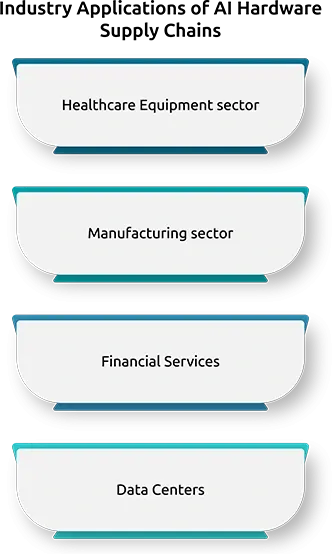
Industry Applications of AI Hardware Supply Chains
Data Centers
Data centers rely on AI hardware supply chains to maintain a continuous supply of GPUs, servers, storage systems, & networking equipment required for AI computing & cloud systems.
Healthcare Equipment sector
Healthcare equipment organizations require advanced AI hardware for medical device imaging, diagnostics, research, & patient data analysis. Reliable supply chains make sure sensitive equipment is delivered without delays.
Manufacturing sector
Production uses AI hardware to support automation, robotics, proactive maintenance, & quality checks systems, making continuous hardware availability important.
Financial Services
Banks & financial organizations rely on AI systems for fraud detection, risk analysis, systematic trading, & customer service applications that require secure, high-performance computing systems.
Telecommunications sectors
Telecom providers deploy AI hardware to improve network performance, automate operations, & improve customer experience through smart network management.
Research & Education
Universities, research systems, & invention centers depend on high-performance AI systems to support scientific research, models, & advanced computing projects
Import and Compliance Considerations for AI Hardware
Importing AI hardware across borders requires careful focus on customs rules, product grouping, & documentation. Valuable equipment such as AI servers, GPUs, storage systems, networking devices, & specialized processors must be classified under the correct HS code to determine applicable duties and taxes. Businesses should also prepare essential documents, including industrial invoices, packing lists, documents of origin where required, & import permits based on the destination country’s regulations. Working with experienced logistics providers and an Importer of Record IOR service helps make sure smooth customs clearance, reduced compliance risks, & prevents shipment delays.
Challenges and Solutions in AI Hardware Supply Chains
AI hardware supply chains face challenges such as component shortages, shipping delays, supplier dependency, & changing trade regulations. These issues can break sourcing & delay AI deployments. Businesses can reduce these risks through supplier expansion, efficient stock planning, real-time shipment tracking, & strong compliance management. Working with experienced logistics & IOR service providers also helps make sure smooth global shipments & customs clearance.
Our Expertise in Global Trade Compliance & AI Hardware Logistics
Our team specializes in global logistics, global trade compliance, & technology supply chain management. With broad experience supporting cross-border shipments of high-value IT & AI infrastructure, One Union Solutions helps businesses manage customs requirements, regulatory compliance, & global logistics with confidence. Our expertise allows companies to deploy AI hardware effectively while reducing risks & maintaining smooth global operations.
Conclusion
A strong AI hardware supply chain is important for supporting reliable AI deployments & long-term business growth. By combining effective logistics, compliance management, & strong planning, businesses can reduce delays & improve working efficiency. One Union Solutions helps organizations simplify global AI hardware logistics through reliable compliance and cross-border shipping expertise.
Did you know?
AI servers depend on 1,000+ semiconductor components, and even a single missing chip can delay the entire production line.
FAQ
What are AI hardware supply chains?
AI hardware supply chains are the networks responsible for sourcing, output, shipping, & delivering AI systems such as GPUs, AI servers, storage systems, processors, & networking equipment required for artificial AI uses.
What are the biggest risks in AI hardware supply chains?
Common risks include supply shortages, supplier dependency, strategic global delays, logistics delays, regulatory compliance challenges, cybersecurity threats, & increasing demand for advanced AI hardware.
How can businesses reduce AI hardware supply chain risks?
Businesses can reduce risks by expanding suppliers, improving stock planning, enhancing compliance processes, monitoring supplier performance, & working with experienced logistics & Importer of Record service providers.
Why is supply chain visibility important for AI hardware?
Supply chain visibility allows businesses to monitor supplier performance, shipment status, stock levels, & capacity delays in real time, helping improve planning & reduce working risks.
How does One Union Solutions support AI hardware supply chains?
One Union Solutions provides global logistics, Importer of Record IOR, customs compliance, & global shipping solutions that help businesses shipping AI hardware securely, effectively,& in compliance with global trade regulations.