Introduction
Artificial intelligence is transforming industries worldwide, driving significant demand for GPUs, AI servers, networking equipment, & advanced data center systems. From large-scale cloud providers to business AI projects, organizations are investing billions to expand their technology capabilities.
Yet while much attention is given to GPU shortages & semiconductor production, other critical challenge often goes overlooked: logistics.
Shipping AI hardware globally is no longer a straightforward transportation task. This valuable equipment requires careful planning, regulatory compliance, secure management, & efficient delivery coordination. Even minor mistakes can affect AI deployments by weeks or months, impacting project timelines and business objectives.
For organizations building AI infrastructure across multiple countries, logistics has become a strategic component of success rather than an operational function.
Why Are AI Data Center Projects Getting Delayed Even After Securing GPUs?
Many companies believe acquiring GPUs is the final challenge in launching AI infrastructure. However, the journey from production to a working data center involves several logistical complexities that are often underestimated during project planning.
From export permit & customs clearance to secure shipping & installation scheduling, every stage of the supply chain introduces possible delays. A shipment that arrives late, gets held for regulatory review, or experiences delivery delays can affect an entire AI project. As global AI investments continue to rise, understanding these hidden logistical challenges has become essential for organizations seeking to scale their operations efficiently & avoid costly challenges.
Export Control Regulations Are Becoming More Complex
AI hardware is increasingly subject to global export control rules. Advanced GPUs, AI processing chips, networking switches, & high-performance technical systems frequently require additional documentation & regulatory reviews before they can be shipped across borders.
Organizations must navigate rapidly changing export restrictions, end-user verification procedures, technology transfer regulations, & multi-country compliance requirements. Failure to meet these requirements can result in shipment holds, denied exports, unexpected penalties & major project delays. As governments continue to improve oversight of advanced technologies, compliance has become a critical requirement in global AI supply chains.
Customs Clearance Delays Can Disrupt Entire AI Deployments
Customs clearance remains one of the most hidden challenges in AI hardware logistics. Due to their high -value & technical complexity, GPUs & AI servers often receive greater scrutiny from customs authorities than traditional IT equipment.
Delays can arise from incorrect HS classifications, incomplete technical documentation, valuation differences, or additional customs reviews. What appears to be a minor paperwork issue can quickly evolve into an extended clearance process. For organizations working under strict deployment schedules, customs delays can postpone installation activities, testing phases, & affecting the return on investment for AI infrastructure projects.
High-Value Shipments Require Enhanced Security
AI servers, networking equipment, & advanced GPUs represent an important investment. Frequently, a single shipment may be valued at a high value of thousands of dollars, making it an attractive target for stealing or unauthorized access during transit.
Traditional shipping methods may not always provide the level of protection required for such sensitive equipment. Businesses must consider shipment tracking, cargo monitoring, secure handling procedures, & risk reduction strategies throughout the shipping process. Even a single security incident can create financial losses & delay critical deployment timelines.
Coordinating Global Multi-Site Deployments Is Increasingly Difficult
Many AI framework projects involve deploying equipment across multiple countries, regions, or data centers simultaneously. While this approach supports business growth, it also introduces significant logistical complexity.
Each destination may have different customs rules, import requirements, shipping timelines, & compliance standards. Managing multiple shipments while making sure synchronized delivery schedules can become challenging, particularly when infrastructure deployment depends on every component arriving on time. A delay affecting one shipment can create a cascade effect that impacts the entire deployment plan.
Data Center Delivery Windows Are Extremely Strict
Unlike traditional warehouses, data centers operate under highly controlled delivery environments. Access is typically controlled by strict security installation collaboration requirements.
Shipments often need to align with deployment teams, equipment installation plans, and operational readiness milestones. If a shipment arrives outside its allocated delivery window, businesses may face replanning challenges & project delays. This makes accurate shipping planning an important component of successful AI infrastructure deployment.
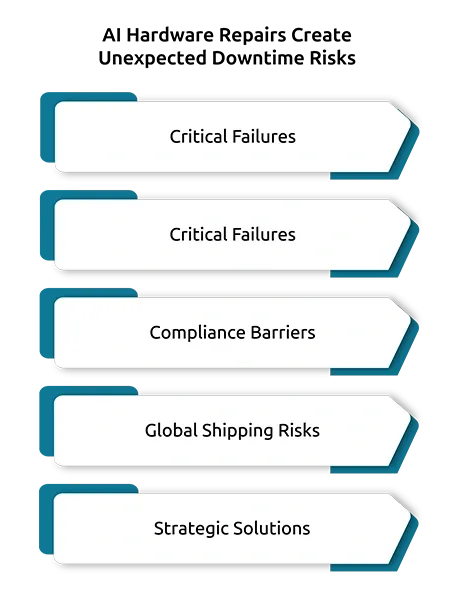
AI Hardware Repairs Create Unexpected Downtime Risks
Even the most advanced AI infrastructure requires system maintenance, repairs, & component replacements. When critical hardware fails, organizations must move quickly to prevent delays to AI workloads & business operations.
Cross-border repair logistics can be specifically challenging due to temporary export procedures, customs documentation requirements, & global shipping factors. Without an effective strategy for handling repairs, organizations may experience extended downtime, reduced productivity, & increased working costs.
Spare Parts Logistics Is Often Overlooked
While organizations dedicate significant resources to acquiring AI hardware, many underestimate the importance of spare parts availability. As AI environments grow more advanced, maintaining access to critical replacement components becomes increasingly important for operational consistency.
A failed GPU, server component, or networking device can greatly impact performance if replacement stock is not easily available. Delays associated with sourcing & shipping replacement parts can extend outages & reduce infrastructure efficiency. Strategic stock planning & prepared spare parts management have become important factors for organizations looking to maintain reliable AI operations.
Sustainability Reporting Is Becoming a New Logistics Requirement
As AI infrastructure extends worldwide, organizations face increasing pressure to understand & reduce the environmental impact of their supply chains. Stability is no longer limited to production processes; logistics activities are also becoming a key focus area.
Shipping planning, packaging improvement,& supply chain transparency all contribute to broader sustainability goals. Businesses that incorporate environmentally responsible logistics practices into their AI infrastructure strategies can improve compliance efforts while enhancing working efficiency.
The Hidden Cost Nobody Calculates: Deployment Delays
Most companies focus heavily on hardware buying costs & shipping costs when financial planning AI infrastructure projects. However, one of the largest risks often remains overlooked: deployment delays.
A delayed shipment can postpone AI model training, slow product development efforts, leave engineering resources partially used, & increase infrastructure expenses. In many situations, the financial impact of waiting exceeds the actual cost of transportation. This reality highlights the growing importance of logistics as a strategic business function rather than simply a supply chain activity.

Conclusion
As global demand for AI infrastructure continues to rise, the challenge is no longer limited to obtaining GPUs & servers. Organizations must also navigate a complex logistics landscape involving export controls, customs regulations, security risks, deployment coordination, repair logistics, spare parts availability, & environmental requirements.
Companies that recognize logistics as a planned component of AI infrastructure deployment will be better placed to speed up project timelines, reduce working risks, & maximize the value of their technology investments. In an increasingly competitive AI landscape, the ability to move critical hardware efficiently across cross border may become just as important as securing the hardware itself. At One Union Solutions, we help businesses overcome these challenges through specialized global logistics solutions, making sure AI hardware moves across borders efficiently, legally, & on schedule.
Did You Know?
Data center capacity demand is projected to grow by ~2.5× between 2022 and 2030, driven by AI workloads.
FAQs
How do export controls affect international GPU shipments?
Export controls can require additional permits, documentation reviews, end-user verification procedures, & compliance checks before advanced AI hardware can be shipped globally, possibly affecting delivery timelines.
Why do AI server shipments experience customs delays?
Customs delays commonly occur because of incorrect product classifications, incomplete documentation, valuation discrepancies, technical reviews, or additional regulatory inspections.
What logistics risks are associated with shipping AI hardware?
AI hardware shipments face risks such as cargo theft, physical damage, customs delays, compliance challenges, transportation disruptions, and delivery scheduling conflicts at data centers.
Why is reverse logistics important for AI infrastructure?
Reverse logistics supports repairs, replacements, upgrades, and warranty management activities, helping organizations reduce downtime and maintain operational continuity.
What should organizations consider when planning global AI hardware deployments?
Organizations should evaluate export regulations, customs requirements, transportation security, deployment scheduling, spare parts availability, repair logistics, and long-term infrastructure support requirements before deployment begins.