Introduction: Why IOR Compliance Matters in Modern Data Centers
Businesses require faster & more flexible IT structures, there is an increase in global demand for modular and containerized data centers. As businesses grow into new markets, more servers, networking equipment, & data center hardware can be shipped globally. However, global data center rollouts can be difficult due to differences in customs rules, import limitations, and document rules in every country. Incorrect documents and compliance can cause shipment delays, extra costs, and project delays. An Importer of Record (IOR) helps companies in import compliance, customs clearance, tax, and documentation. IOR services make sure that data center equipment follows with local rules, allowing for smooth and efficient global data center deployments.
Understanding Modular & Containerized Data Centers
Modular data centers and containerized data centers are built-up facilities that include servers, storage systems, power units, and cooling equipment in a single, ready-to-use space. These solutions are easily flexible as the needs of the company grow. Many businesses choose this kind of data center because it is simpler to build, has more flexibility, and less costs to deploy than traditional facilities. The units can be delivered and installed much faster because they are prebuilt. Pre-configured data center units frequently change to multiple countries to support global digital infrastructure projects. However, every shipment has to pass through local customs process and follow all import rules. This makes clear the value of proper documentation and compliance for a smooth delivery and deployment process.
Why Early Import Planning Matters for Global Data Center Projects?
Planning import requirements before shipping data center equipment helps businesses reduce customs delays & unexpected compliance issues. Reviewing import documents, product details, permits, & import regulation in advance supports a smoother customs process. Early planning between logistics, compliance, & deployment teams also improves delivery timelines & reduce project delay. Careful import planning helps modular & portable data center projects stay on schedule while avoiding extra costs & working delay.
What is IOR in Data Center Deployments?
An Importer of Record (IOR) is a business or service provider who takes legal responsibility for importing data center equipment into a country. It allows companies to ship IT hardware across borders while following to local import rules. The IOR is in charge of important tasks such as customs processing, import documents, duty and tax payments, and compliance with local trade rules. This helps make sure that shipments are properly cleared and delivered without unnecessary delays. Many businesses depend on IOR services when they do not have a registered company entity in the destination country. With an IOR, they can legally and efficiently import servers, networking devices, storage equipment, and other technical devices.
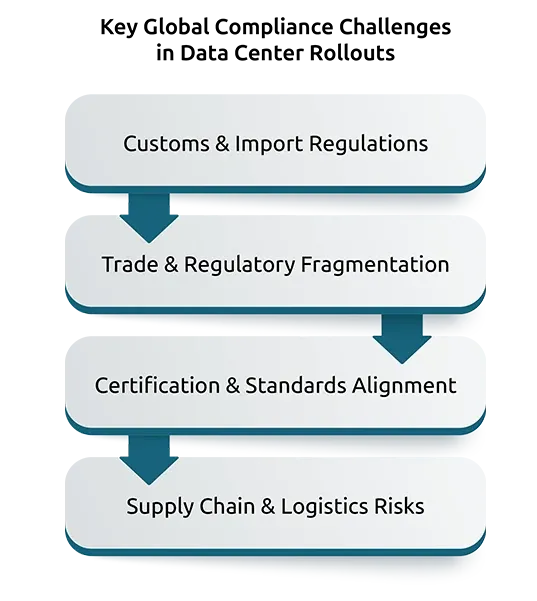
Key Global Compliance Challenges in Data Center Rollouts
Customs & Import Regulations
Every country has different import rules for servers, networking equipment, power systems, & other data center equipment. To follow with local rules, businesses must provide correct shipping documents & product details. Missing or incorrect paperwork could result in to customs delays & slow down project timelines.
Trade & Regulatory Fragmentation
Global data center projects sometimes include multiple countries, each with its own specific trade rules & compliance needs. Rules that apply in one location may not apply in another, making it difficult to maintain clarity in the import process across global markets.
Certification & Standards Alignment
Many countries require data center equipment to meet particular safety, quality, security, and energy performance demands. Before deploying any modules or infrastructure parts, companies must confirm that they meet the required certifications.
Supply Chain & Logistics Risks
Data center projects typically include hardware from different kinds of sources and manufacturers. Managing shipments from different locations increases the risk of shipping delays, damaged cargo, customs checks, and delivery delays that may affect deployment timetables.
Compliance Framework for Global Data Center Rollouts
A successful global data center rollout begin with careful planning before any equipment is shipped. Businesses should review country-specific import rules, prepare the required documents, and identify product classifications and licensing needs. Correct planning helps to avoid compliance difficulties and reduces the chance of delays. During this stage, One Union Solutions helps companies in handling import requirements and documents to make sure a smooth global shipping. Customs clearance and transportation become the most important purpose of the shipping process. An Importer of Record (IOR) helps with the management of import processes, tariffs, taxes, and cross-border cargo shipments. One Union Solutions helps companies with customs compliance and import management, making sure that data center equipment reaches at its location without unnecessary delays.
After the equipment arrives, installation and deployment can start. Companies may be must carry out local inspections and follow to safety, environmental, and industry rules. One Union Solutions helps businesses in following these compliance standards, enabling efficient and compliant data center deployments in global markets.
Conclusion
Import compliance has become an important part of successful deployment as modular & containerized data centers grow in global markets. IOR services help businesses in handling customs processes, import documents, & local rules, reducing the risk of delays and issues. Companies focusing on compliance needs early in the process may support faster, smoother, & more flexible data center rollouts. One Union Solutions helps companies in handling global import processes and regulatory rules, making global data center deployments easier and reliable.
Did you know
The global containerized data center market is expected to grow from USD 16.29 billion in 2025 to USD 114.7 billion by 2035, showing strong demand for scalable data center solutions.
FAQ
What is an Importer of Record (IOR) in data center deployments?
An Importer of Record (IOR) is a service provider that is in charge for importing data center equipment into a country and making sure compliance with local import rules.
How can businesses reduce customs delays during data center deployments?
Accurate import documents, correct product classification, and early compliance planning help reduce customs delays. An experienced IOR provider also helps manage destination-country import requirements.
What are the primary compliance challenges for global data center deployments?
Businesses usually face different import rules, legal rules, certification criteria, & customs processes in every country.
What documents are commonly required to import data center equipment?
Common documents involve the commercial invoice, packing list, bill of shipping documents or air waybill, & any country-specific permits or certifications required for customs clearance.
Can a company import data center equipment without a local entity?
Yes. An IOR can act as the legal importer, allowing businesses to import servers, networking equipment, & other IT infrastructure without setting up a local entity.