The international supply chain is mainly changing, managed by manufacturers around the world in an effort to limit risk, build trust, cover costs, & explore new markets for production. As many developers want to minimize their reliance on a single supply source, Southeast Asia is growing as an important development hub, as shown in the production changes in the region.
Some countries in the region are developing their manufacturing strength & developing the transport & logistics network needed to support export demand. If regional trade continues its current upward direction, there may be room for logistics companies to support this growth. Our analysis suggests a gap of around $60 billion between working or announced infrastructure investment & what could be needed to meet future trade issues. This gap provides opportunities for private investors, logistics companies, & other partners to increase the development of logistics in the country.
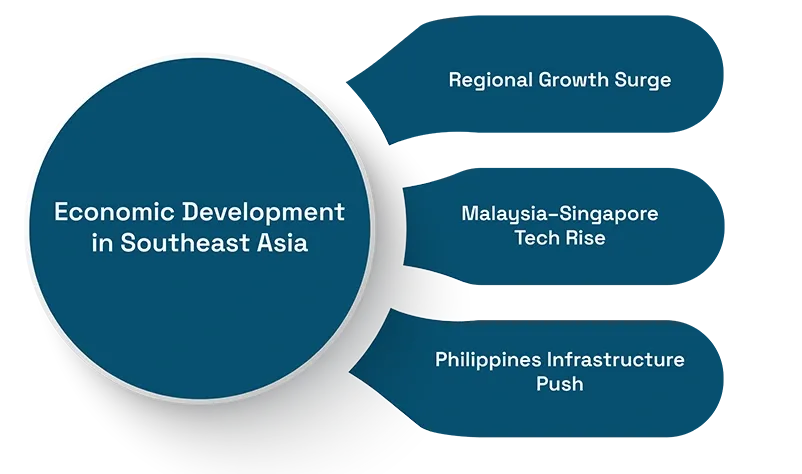
Economic Development in Southeast Asia
Southeast Asian economies are experiencing strong, updated growth in 2026, with regional GDP growing faster than the global standard. Vietnam is growing, when Indonesia, Malaysia, & Singapore show strong progress in management & services. The region is improving from supply chain changes, digital economy growth, & fast foreign investment.
Regional Economic Drivers & Trends (2026):
Southeast Asia is developing as one of the fastest-growing economic regions in the world, led by strong industrial growth, digital transformation, & developing foreign investment. Vietnam has become a developing performer in the region, recording economic growth of over 8 percent due to its main improvement of the manufacturing & export sectors. Indonesia continues to lead the regional economic ecosystem with an estimated purchasing power parity GDP of nearly $5.45 trillion, supported by constant industrial growth & a strong manufacturing base, while its economy is expected to grow by around 5.1% in 2026. Malaysia & Singapore are showing important growth in electronics management, semiconductor manufacturing, & digital industries, improving their positions in global supply chains. The country’s digital economy is also developing rapidly & is expected to overcome $330 billion by 2025, with Indonesia audit for the largest share of this global growth.
Growth prediction & Sector Focus (2025-2026):
The Philippines manages strong economic growth, with development forecast between 6.0% & 6.1%, supported by growing spending, sustainable transfer of incoming funds from international workers, & main infrastructure development projects. Thailand’s economy is also gaining pace as tourism rebounds strongly & public investment in transportation & network expands across the country. Singapore, despite being a mature economy, continues to show stable performance with projected growth of around 2.4% in 2026, driven by advanced manufacturing, financial services, & technology sectors. Southeast Asia, some common factors are boosting regional economic expansion, including increasing consumer demand, booming electronics exports, rapid industrialization, & the growth of a growing middle-class population with higher purchasing power.
Government Actions Supporting Trade
The Indian government, as of 2026, supports trade through the Export Promotion Mission, focusing on improving MSME inclusion, improving trade finance via NIRYAT PROTSAHAN, & updating logistics through NIRYAT DISHA. Main plans include the RoDTEP scheme, districts as export hubs, & recent FTAs, added with the India-UK CETA (2025).
Government Trade Support Initiatives (2025-2026):
India is enhancing its export ecosystem through some government-led initiatives managed to improve global trade efficiency & support exporters across industries. One of the main upgrades is the Export Promotion Mission, approved in November 2025, which joins many export-related schemes into a unified framework aimed at raising export performance, mainly for MSMEs, labour-intensive industries, & first-time exporters. Supporting this initiative, the Niryat Protsahan program focuses on improving financial access for exporters through measures such as interest grants, credit assistance, & collateral support. Niryat Disha is focused on improving export readiness by improving logistics network, warehousing capabilities, trade intelligence, & market access support. These initiatives are helping Indian businesses improve their global presence in the whole world & compete more easily in global markets.

Conclusion
Southeast Asia is mainly positioning itself as one of the world’s most important export & manufacturing destinations, driven by strong economic growth, growing industrial capabilities & developing global investment. As companies continue extending supply chains & minimizing dependency on single-market sourcing, countries across the region are benefiting from increased manufacturing activity, improving infrastructure, & growing digital economies. From electronics & semiconductor production to customer goods & logistics services, Southeast Asia is mainly creating opportunities for exporters & global businesses.
Did you know?
Asia’s GDP growth outperformed in 2025, driven by robust exports and tech-led investment – but a slowdown in external demand points to reduced momentum ahead.
FAQ
1. Who is the largest exporter in Southeast Asia?
Singapore leads ASEAN Member Countries in exports, with more than half of the total ASEAN exports.
2. Why is Southeast Asia growing so fast?
The fastest economic growth in Southeast Asia is driven by strong regional demand, digital adoption, and increasing foreign investment across ASEAN economies. The economies of Southeast Asia are highly diverse, ranging from advanced markets like Singapore to emerging economies like Vietnam and Indonesia.
3. Why is everyone going to Southeast Asia?
Southeast Asia captivates every traveller with its rich cultures, extraordinary landscapes, and unforgettable experiences. From ancient traditions and world-class cuisine to lush rainforests, idyllic island escapes, and seamless multi-centre travel, the region offers remarkable diversity at every turn.
4. Is ASEAN the world’s 4th-largest economy?
With a collective GDP of over 4 trillion dollars, ASEAN is already the world’s 4th largest economy and is growing 25 percent faster than the global average.
5. Which country will be the world’s largest economy by 2030?
China ranks first in total GDP added, projected to expand by $5.7 trillion between 2026 and 2030. The United States follows closely behind at $5.0 trillion. Despite slower percentage growth compared to emerging markets, their sheer size means even modest expansion translates into massive dollar gains.