Overview
Exporting Class 2 and Class 3 medical devices is more difficult than shipping goods. These goods directly affect safety, which means regulatory officials across countries have strong approval processes before allowing exports or import processes. If you are working with country-specific export approvals must be carefully managed to avoid delays, penalties, or rejected shipments. Exporters must not only follow local regulations but also follow the country’s medical approval requirements. Regulatory approvals with HS code categorizations, HTS Harmonized Tariff Schedule, customs clearance, and international shipping terms are necessary in global trade.
What Are Class 2 and Class 3 Medical Devices?
Medical devices are categorized based on the risk level of the goods. Regulatory officials such as the U.S. FDA, the European Medicines Agency (EMA), and other national health authorities categorize devices to confirm exact levels of control.
Class II Medical Devices
Class II devices are considered moderate-risk products. They require more regulatory controls than Class I devices but are not as highly regulated as Class III.
These devices typically require:
Pre-market notification or approval
Technical paperwork of devices
Performance and safety testing of goods
Quality management system approval, such as ISO 13485
Class III Medical Devices
Class III devices are high-risk and usually sustain or support life, are used, or present a huge risk if they fail in global trade.
These devices require:
Extensive clinical data
Pre-market approval (PMA
Detailed risk evaluations
Strong post-market scrutiny
Because of their risk level, Class 3 products undergo stronger export approval scrutiny in most countries.
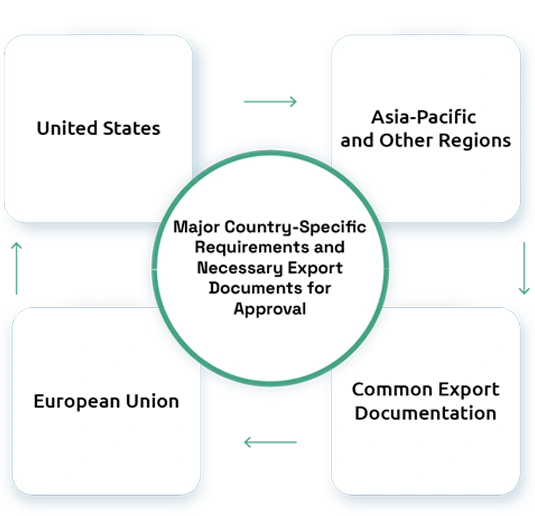
Major Country-Specific Requirements and Necessary Export Documents for Approval
Every country has its own regulatory system governing the export and import of Class II and Class III medical devices.
United States
For exports from the U.S., the FDA may require:
Certificate to Foreign Government (CFG)
Proof of FDA registration
United States
For exports from the U.S., the FDA may require:
Certificate to Foreign Government (CFG): Validated electronically via the FDA’s e-portal.
Proof of FDA registration: Annual establishment registration and fee payment (FY 2026 fee: $11,423).
Device Registration and UDI Listing:
Continuous maintenance of device listings in the FDA Unified Registration and Listing System (FURLS).
Quality Management System Regulation (QMSR): Compliance with the new FDA QMSR framework (replacing the old QSR), which now mandates alignment with the international ISO 13485:2016 standard.
Accurate HS codes and HTS Harmonized Tariff Schedule categorizations are necessary for customs approval and tariff estimation of the supply chain.
European Union
Under the EU have their Medical Device Regulation (MDR), exporters must confirm:
CE marking
Usage of Conformity
Technical paperwork
Authorized Representative (if applicable)
Customs clearance procedures require correct product description, categorizations, and correct Incoterms such as DAP or International shipping terms for the supply chain.
Asia-Pacific and Other Regions
Countries such as Japan, Australia, India, and China have their own medical device regulatory authorities. They may require:
Local registration or marketing authorization
Clinical evaluation reports
Import licenses
Free Sale Certificates
In some cases, working with an Importer of record Service is necessary to meet local approval problems.
Common Export Documentation
Across most administrative areas, exporters must prepare:
Trade invoice
Packing list
Certificate of origin
Regulatory approval certificates
Transport documents
Product technical case study
Effective inventory and order management and supply chain optimization reduce delays in approval and shipping.
What Are Export Approval Process for Class II & Class III Medical Devices
The export approval process usually involves several coordinated steps:
Step 1: Product Classification
Correct categorizations under regulatory standards and tariff systems, including the exact HS code, confirm accurate regulatory and customs approval.
Step 2: Regulatory Authorization
Local regulatory clearance before export. This may require FDA approval, CE marking, or similar national authorization of the supply chain.
Step 3: Documentation Preparation
Prepare approval certificates, quality documentation, and trade shipping documents worked with customs broker requirements.
Step 4: Partner Expertise
Working with exporter of record services and importer of record Service providers to confirm legal responsibilities in both exporting and importing countries.
Step 5: Shipping and Customs
Select the correct Incoterms, such as DAP, and work them with agreement problems. Confirm smooth customs clearance and premium delivery service to maintain the product integrity of shipping.
Complete this process, working between logistics partners and customs experts, is necessary to stop shipment holds or rejections in the supply chain.

Conclusion
Country-specific export approvals for Class II and Class III medical devices require careful regulatory planning, correct documentation, and a strong working partner in global trade. From categorizations and regulatory clearance to customs procedures and international shipping terms, every step must work with both origin and destination requirements. Combining approval expertise, systematic supply chain optimization, and dependable international freight services, exporters can reduce risk and confirm the timely global supply of necessary medical technologies.
DID YOU KNOW?
In January 2025, the FDA published a draft guidance document for AI-enabled medical devices, covering both lifecycle considerations and marketing submissions
FAQs:
1. What is the difference between Class II and Class III medical devices?
Class II medical devices are moderate-risk products that require pre-market notification, technical documentation, and quality management compliance. Class III devices are high-risk, life-supporting, or life-sustaining products that require extensive clinical data, pre-market approval (PMA), and strict post-market surveillance.
2. What documents are required to export Class II and Class III medical devices?
Common export documents include a commercial invoice, packing list, certificate of origin, regulatory approval certificates (such as FDA or CE), transport documents, technical documentation, and proper HS code classification.
3. Is FDA approval required for exporting medical devices from the United States?
Yes, in many cases, exporters must provide a Certificate to Foreign Government (CFG), proof of FDA registration, device listing, and compliance with Quality System Regulation before exporting.
4. Why is HS code classification important in medical device exports?
Accurate HS code and HTS Harmonized Tariff Schedule categorization confirm proper customs clearance, correct tariff calculation, and approval with international trade regulations.
5. Can I export without an IEC code?
No, you cannot export without an IEC. It is a legal requirement for Indian customs and for getting paid through your bank.