

Overview
In the global healthcare trade, agreements go far beyond customs documentation and shipping schedules. One area exporters are frequently unfamiliar with is Good Distribution Practice (GDP). While both the World Health Organization (WHO) and the European Union (EU) provide GDP guidelines, their expectations regarding the supply chain are not similar. Exporters involved in international freight services, customs clearance, and regulated supply chains frequently miss small but critical differences that can grow to shipment delays, penalties, or rejected shipments. Understanding how the WHO and EU GDP rules apply during export operations is necessary for exporters managing international shipping terms, Incoterms, and a difficult logistics chain.
What is the difference between WHO and EU GDP guidelines?
WHO GDP guidelines are flexible and act as global recommendations. They provide a general framework for the safe storage, handling, and transportation of medical products. These guidelines are mainly used by countries as a reference to build their own regulations, especially in developing markets. They focus on best practices but are not legally binding.
What Does Good Distribution Practice (GDP) Cover During Exporter Operations?
Scope of GDP in Export Activities
Good Distribution Practice confirms that medicinal products are consistently stored, managed, and transported under suitable conditions. For exporters, GDP takes every stage from warehouse to ship to final delivery, whether shipments move under DAP or other Incoterms.
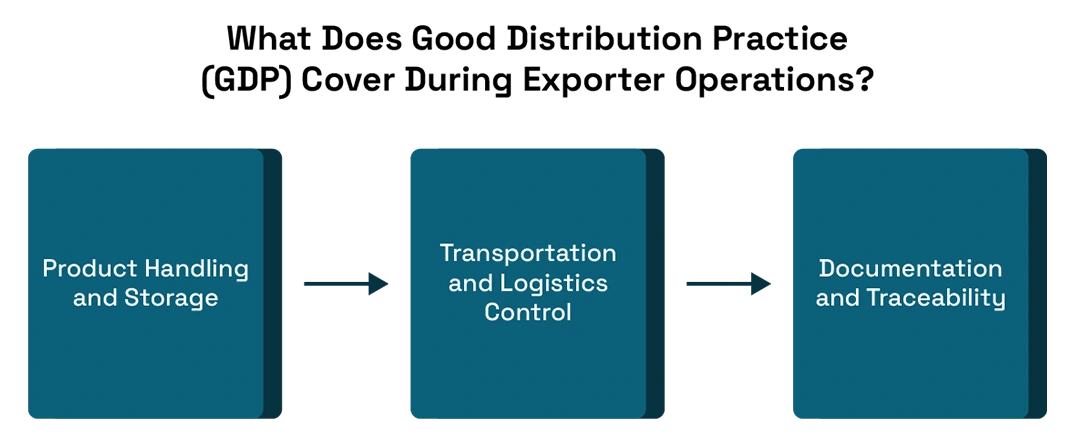
Key Exporter Responsibilities Under GDP
Product Handling and Storage
Exporters must maintain controlled storage conditions, including temperature monitoring and inventory and order management systems that prevent mix-ups or contamination.
Transportation and Logistics Control
GDP requires validated transport routes, qualified logistics partners, and documented international freight services. Even when using premium delivery service options, responsibility does not end once goods leave the warehouse.
Documentation and Traceability
Accurate documentation, including HS code categorizations and alignment with the HTS Harmonized Tariff Schedule, supports both GDP approval and smooth customs broker processing.
Why Are Good Distribution Practices Important for Exporters?
Regulatory Approval and Market Access
GDP approval is frequently mandatory for access to regulated trades, mainly in the EU. Failure to comply may override benefits gained through trade systems such as the Generalized System of Preferences (GSP).
Risk Minimizes Across the Supply Chain
Proper GDP usage reduces risks related to product degradation, theft, or diversion. This is especially important when exporter of record service or importer of record service providers are involved across borders.
Brand Reputation and Trust
For medical exporters, GDP violations can damage reputation with regulators, distributors, and end customers. Supply chain optimization under GDP standards improves long-term business relationships between countries.
What Is the Role of the WHO and the EU in GDP Rules for Exporters?
WHO GDP Guidelines
Global Reference Systems
WHO GDP guidelines work as an international standard, specifically for developed and developing markets. They provide flexible, principle-based guidance suitable for various regulatory trades.
Support for International Trade
WHO standards support harmonization across borders, helping exporters guide international shipping terms and mixed regulatory expectations of the supply chain.
EU GDP Guidelines
Legally Workable Requirements
EU GDP rules are legally permanent within the European Economic Area. Exporters supplying the EU must follow anyway of whether they work under DAPs or other delivery methods.
Higher importance on Accountability
EU regulators place strong importance on documentation, audits, and defined responsibilities between exporters, logistics providers, and importer of record service providers globally.

What Are the Common and Typical GDP Violations Done by Exporters in Global Trade?
Insufficient Temperature Control
One of the most frequent disruptions is poor temperature tracking during international shipping, mainly when using third-party logistics providers without exact GDP training in global trade.
Weak Role Definition Under Incoterms
Exporters frequently support that responsibility ends after handover under Incoterms such as DAP. However, GDP accountability may still apply depending on the arrangements.
Poor Documentation and Recordkeeping
Missing transport records, incorrect HS code declarations, or misaligned customs clearance documents can show both GDP and customs approval issues in goods.
Unqualified Logistics Partners
Using low-cost international freight services without GDP validation is another mistake that undermines approval efforts for shipments.
Conclusion
WHO and EU GDP rules share the same objective, protecting product quality and patient safety, but differ in execution and operational expectations. Exporters who depend completely on WHO guidance may fall short when supplying EU markets, while those focused only on customs broker requirements may see necessary GDP problems. Working with GDP approval with supply chain optimization, clear role definitions, and strong logistics controls, exporters can reduce risk, improve efficiency, and maintain access to regulated global trades. In an increasingly scrutinized trade environment, knowing what the WHO and EU GDP rules truly demand is no longer optional; it’s a competitive necessity.
DID YOU KNOW?
India’s medtech imports reached $8.2 billion in FY24, while exports reached $3.8 billion. With the right policy support, exports can grow to $15-20 billion by 2030, as estimated by the Confederation of Indian Industry (CII).
FAQs:
1. What is Good Distribution Practice (GDP) in export operations?
Good Distribution Practice confirms that medicinal products are stored, handled, and transported under controlled conditions throughout the export process to protect quality and patient safety.
2. How do the WHO GDP guidelines differ from the EU GDP rules?
WHO GDP guidelines are principle-based and flexible, while EU GDP rules are legally enforceable with stricter documentation, audits, and accountability requirements for exporters.
3. Do exporters remain responsible under GDP after goods leave the warehouse?
Yes. GDP responsibilities may continue during transportation and delivery, even when Incoterms such as DAP are used, depending on contractual and regulatory obligations.
4. What are the most common GDP violations by exporters?
Typical violations include poor temperature monitoring, incomplete documentation, unqualified logistics partners, and unclear role definitions under Incoterms.
5. Why is GDP compliance important for accessing EU markets?
GDP compliance is frequently mandatory in the EU. Non-compliance can lead to shipment rejection, penalties, and loss of market access despite customs or trade benefits like GSP.