
Active and reliable

CBP, BIS, FDA, USDA

English

End to End IOR

2-4 business days
We navigate the logistics, regulations, and compliance, connecting global businesses to a growing digital economy. We help you import compliantly, reduce risks, and accelerate your time to market.
















What is an Importer of Record (IOR)?
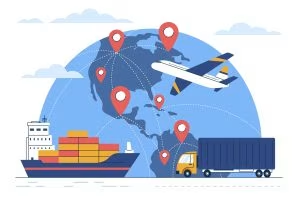
Someone or a legal organization recognized as in charge of meeting all customs requirements related to importing goods into a nation is an Importer of Record (IOR). This means the IOR is included in all import documents and bears legal responsibility for guaranteeing adherence to import limitations and customs laws.
In international trade, the IOR is essential. Important duties include: Ensuring that imported commodities comply with all relevant customs laws, regulations, and duties is known as customs compliance. Documentation: Creating and submitting import declarations, invoices, and permits, among other necessary customs paperwork. Tariffs Payment: Compiling and paying import taxes, tariffs, and levies. Risk management: Involves determining and reducing any fines and hazards related to customs.

Compliance with customs laws is essential for companies that deal internationally. Serious consequences including fines, confiscation, and legal ramifications may arise from noncompliance. As the IOR, the person or entity bears the legal obligation to guarantee compliance with all import rules, thereby insulating the importing company from any potential liability.
There are several benefits to assigning IOR duties to a specialist service provider, including:
Simplified Customs Clearance: IOR services are well-versed in customs laws and procedures, they can clear goods quickly and efficiently.
Risk management: IOR services are skilled in detecting and reducing customs risks, protecting companies from any problems.
Simplified Documentation: By managing the intricate documentation involved in imports, IOR help organization save time and money.
Assurance of Compliance: IOR services maintain current knowledge of changing customs laws to guarantee continuous compliance.
Cost Efficiency: IOR services help reduce costs by expediting the import procedure and reducing customs delays.
Businesses importing goods into New Hampshire may face issues such as customs delays, incorrect documentation, changing import regulations, and compliance risks. Even minor errors in paperwork or tariff classifications can affect shipment timelines and increase operational costs. An experienced Importer or Record helps businesses manage these processes smoothly by handling compliance requirements, customs procedures, and import documentation efficiently.
At One Union Solutions, we are dedicated to making international trade as seamless and efficient as possible for businesses in New Hampshire. Here’s why you should partner with us:
We handle paperwork, compliance, and customs clearance to guarantee efficient and quick import procedures.
We make sure your imports comply with all legal requirements by taking advantage of our in-depth knowledge of local legislation and our profound expertise in it.
We assume legal accountability for your imports, lowering risk and ensuring any necessary compliance.
Enjoy dependable, prompt service, with imports arriving in as little as seven days.
Get specialized solutions and committed customer support that are catered to your unique requirements.
To support its infrastructure, New Hampshire’s tech industry imports essential IT and data center hardware, such as servers and storage systems for data management, networking hardware like switches and routers for reliable network connectivity, cooling systems for maintaining data center temperatures, and uninterruptible power supplies for reliable power and outage protection. The state’s developing technological landscape depends on these imports.
The aviation industry in New Hampshire depends on important imports like aircraft engines, parts, & other components required for maintenance and safety. It also includes communication systems for smooth flight operations and support equipment used in aviation activities. These imports are important for ensuring safe, efficient, and reliable operations within the aviation sector.
To provide top-notch patient care, New Hampshire’s healthcare system is dependent on imported medical equipment. Important imports include surgical instruments for a range of medical procedures, patient monitoring systems like ECG monitors and infusion pumps, and diagnostic imaging equipment like MRI machines and CT scanners. These vital resources support healthcare facilities in offering cutting-edge and trustworthy medical care.
The automotive sector in New Hampshire imports a variety of parts and components that are essential for car manufacturing and maintenance. This covers parts for engines such as crankshafts and pistons, parts for transmissions, such as clutches and gearboxes, and electronics and sensors for performance monitoring and vehicle diagnostics. These imports are critical to preserving car dependability and assisting regional manufacturers.
In 2025, New Hampshire imported $10.1B, making it the 40th largest importer out of the 54 states in the United States.
Some of your burning questions answered.
An Importer of Record (IOR) is responsible for making sure that all imported goods follow local laws and customs rules. The IOR handles documentation, pays duties and taxes, and ensures everything is compliant.
Businesses in New Hampshire usually deal with difficult import rules and documentation. IOR services help simplify the process, reduce delays, and ensure that all legal requirements are properly followed.
Yes, temporary imports may still require proper customs documentation and compliance procedures depending on the type of goods being shipped.
IOR services are commonly used for importing IT equipment, aviation parts, medical devices, and automotive components, especially when strict regulations are involved.
Yes, incorrect documentation, tariff classifications, or missing permits can lead to customs delays, penalties, and additional operational costs during the import process.